






Zone 2 vs Zone 3 for Mitochondrial Health: What Studies Show
Zone 2 cardio exercise is trendy for longevity, but Zone 3 exercise also improves fitness and mitochondrial health. Learn about heart rate zones.

What to know
Zone 2 exercise is an easy effort level where the body predominantly uses fat for fuel.
Zone 3 exercise is a little harder and uses more carbohydrate for fuel.
Both zones improve fitness and mitochondrial health. Going into Zone 3 does not undo the longevity benefits of Zone 2.
Zone 2 is especially useful if you’re training four or more times per week. If you’re exercising three times per week, zones are less important.
Elite athletes train in all five zones. You should, too.
More effort doesn’t necessarily mean more results. Heart rate zones sort cardio into bands of effort where your body burns different fuels and adapts in different ways: easy Zone 2 mostly burns fat, while slightly harder Zone 3 burns more carbohydrate.
Despite the hype, staying in Zone 2 may not be as much of a must as it seems for most exercisers, and the physical stress of Zone 3 may not need to be such a mental stressor.
“With Zone 2, we overthink it,” says Brian Passenti, a UESCA-certified ultrarunning coach and founder of Altitude Endurance Coaching. “Just get moving, and we’ll work out the details later.”
Read on to get the details: How Zones 2 and 3 are different, how both can lower disease risks and improve cardiovascular health, and when and how to worry about the zones you’re exercising in, with advice from Passenti and Mike Nelson, Ph.D., adjunct professor at the Carrick Institute and founder of Extreme Human Performance.

Zone 2 vs. Zone 3: What’s The Difference?
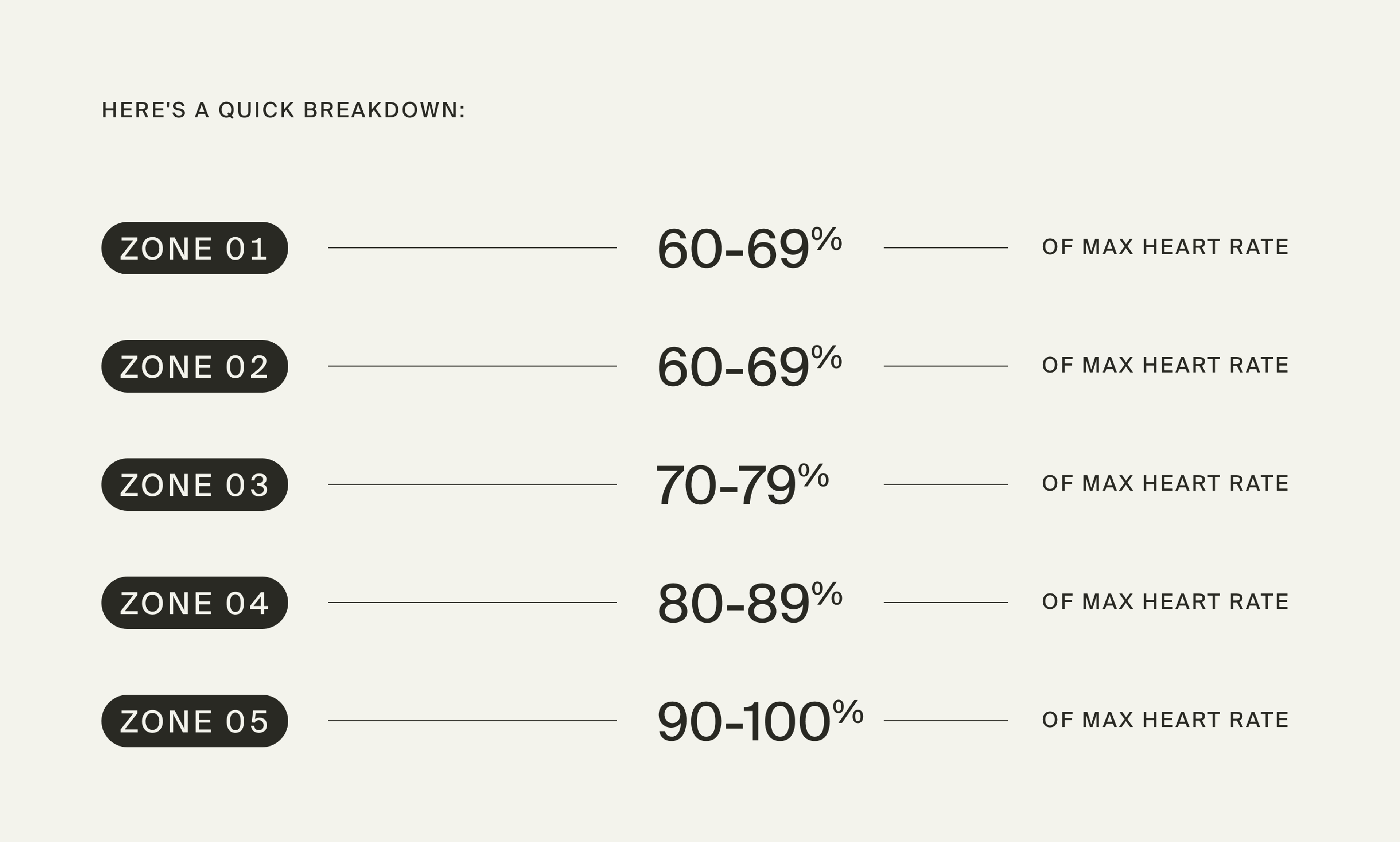
The difference between Zone 2 and Zone 3 is intensity and fuel: Zone 2 is a relatively easy effort (about 60-70% of max heart rate) that burns mostly fat, while Zone 3 is moderately hard (about 70-80% of max) where your body shifts toward carbohydrate and lactate begins to build.[1]
These two zones are part of a five-zone framework first proposed in 1992 to describe exercise intensities. This model classifies exercise based on heart rate, with different percentages of a person’s maximum heart rate corresponding to different heart rate zones. The lowest zone, Zone 1, is associated with easy activity. The hardest, Zone 5, basically describes all-out sprints.
The distinction between Zones 2 and 3 is considered to be special for another reason. In Zone 2 training, you’re using a certain type of muscle fiber that burns more fat for fuel. In Zone 3, you shift to more carbohydrate utilization. Zone 3 training can also make it harder to talk, and lactate has begun to build up in your muscles, creating a burn that might encourage you to stop moving.[2]
What are the Benefits of the Heart Rate Zones?
Every zone delivers benefits: Zone 2 builds your aerobic base and is simple to recover from, while Zone 3 cuts disease risk faster per minute of effort.
Cardiovascular exercise creates a host of benefits across the training zones. When a greater percentage of exercise is more vigorous (a.k.a. in Zones 3 and above), disease risks may be reduced more drastically: Studies suggest that when vigorous activity makes up just 4 percent of weekly exercise, the risk of diabetes and dementia is reduced by 60 percent, and all-cause mortality risk is reduced by 46 percent.[3] But more moderate exercise also impacts longevity.
That’s where the truly unique benefit of Zone 2 comes in: People can do a lot of it and still recover to exercise more the next day. When athletes train every single day, the stress from harder efforts can add up. This can increase their risk of injury or just fatigue them so that on the days they’re supposed to train hard, they don’t have the energy to give their all. This has earned Zone 3 training the moniker of a “gray zone,” and it’s why it’s been unfavorably compared to Zone 2 for endurance training schedules.
“It shouldn’t be taxing on the body, or as taxing as Zone 3,” Passenti says. “If you’re going a little too hard, you might not get the benefits of your recovery.”
People use Zone 2 this way when they’re training for endurance events with a method called “polarized training,” also known as an 80-20 split.[4] The idea is that 80 percent of the time, exercise should be at low intensities, like Zones 1 and 2. The other 20 percent of training will be at much higher intensities, Zones 4 and 5. Many recreational exercisers feel like these lower-intensity efforts won’t give them any adaptations at all, but Passenti points to some of the world’s best to make the opposite case.
“The entry-level athlete just needs to get moving … let them run in Zone 2, Zone 3, whatever it is,” Passenti says. “I think we separate Zone 2 and 3 really into the more performance-based athlete looking for that 5-K personal best, looking to hit the half marathon goal time that we want to match from 10 years ago.”
These athletes can also benefit from some Zone 3 training, he says. Both the performance-based athlete and the person running or cycling a few times per week for cardio will get some unique benefits from this middle-ground zone.
“You’ll see gains in your cardiovascular health. Your ability to flush and move blood through your body, to flush lactate that builds up as a byproduct of your exercise,” he says. “You’re also looking to increase the ability of your cardiovascular system to handle the workload, and also the muscular system to handle the workload you’re asking of it.”

Which Heart Rate Zone is Best for Mitochondrial Health?
For mitochondrial health, no single zone wins.
Endurance training raises mitochondrial volume mainly by enlarging existing mitochondria, not by creating new ones,[5] and a 2025 review found no support for the idea that Zone 2 is uniquely optimal; higher intensities stimulate mitochondrial adaptations and mitochondrial biogenesis at least as well.[6]
You can also support mitochondria from the inside. Mitopure® (Urolithin A) is clinically proven to revitalize mitochondria by stimulating mitophagy, the natural recycling process that clears out worn-out mitochondria, and it supports mitochondrial function and cellular energy. In a clinical study, sedentary middle-aged adults who took Mitopure increased muscle strength by up to 12% over four months.[7]*
How Do You Find Your Max Heart Rate for Zone Training?
You can estimate your maximum heart rate quickly, then let effort confirm it. The classic shortcut is 220 minus your age. The Tanaka equation, 208 - (0.7 × age), tends to be more accurate for older adults. Most smartwatches and chest straps estimate your max and show live zones on your wrist, so you can see when you drift from Zone 2 into Zone 3. Formulas are only estimates, though; anchor them to how you feel.[8]
How to Train in Zone 2: Protocol and Exercise Examples
To train in Zone 2, keep the effort easy enough to hold a conversation for 20-30 minutes, an incline walk, easy cycling, or a relaxed jog.
Most exercisers don’t need to worry about being in Zone 2, Passenti says. If you’re doing some cardio three times per week, he says, just go run or ride your bike at comfortable paces, and don’t worry about zones.
Once you hit four sessions per week, Passenti suggests working in some Zone 2 cardio. At this level of weekly effort, he’d suggest doing one session that includes some higher-intensity speed, with some intervals of three minutes on, three minutes off in Zone 4. One session, he says, can be a longer, sustained effort that goes a little further than you normally would. This might combine some Zone 2 and Zone 3 work. For the remaining two efforts, he says, focus on really easy Zone 2 work.
“These are complementing the other two workouts without affecting the ability to perform those other two workouts [for speed and distance],” he says. With the Zone 2 workouts, “you’re not trying to leave yourself fatigued for the next day. They should actually make you feel refreshed and ready to go for the next day’s workout.”
When you’re starting out with Zone 2, Nelson says, you may not even be able to run at this intensity at all. People who haven’t been running for a while may be more inefficient, he says, and their heart rate may go into higher zones even when running slowly. For exercisers like this, using a bike (stationary or not) or even walking at an incline can elevate the heart rate into Zone 2.
To make sure you’re staying there, keep track of how well you can talk. If you can comfortably hold a conversation at the pace you’re walking, running, or cycling, but the person on the other side of the conversation could tell you’re exercising, you’re in the sweet spot. Try to maintain that level of effort for 20-30 minutes.
How to Train in Zone 3: When and How to Use It
Zone 3 is worth using in short, smooth doses: it can improve running economy and adds time-efficient vigorous activity, but it’s easy to overdo.
Most exercisers who are just trying to stay fit and get their 150 minutes of moderate activity per week don’t need to stress about zones, Nelson reiterates. That means that popping up into Zone 3 is OK and even provides some additional benefits. If you’re running, for example, this level of effort may improve your running economy and efficiency, meaning when you do try to do easier efforts, you’ll actually be able to run in the lower zones.
And Zone 3 may provide some “vigorous” activity, which is powerful for healthspan: An October 2025 study found that each minute of vigorous activity is worth 4-9X as much as a minute of moderate activity when it comes to longevity.[9]
But when many people “just go for a run,” they actually wind up spending time in the upper regions of Zone 3 and into Zone 4, Nelson says. This is uncomfortable and could be why they hate to run.
“I like frequency more than one heroic session per week,” he says. To keep things frequent but manageable, he says, go for short and smooth. “Go run, and make it as smooth and quiet as possible,” he says. See how long you can maintain this smooth, quiet pace. If it’s three minutes or five minutes, that’s great. For many beginners, this effort will still be in Zone 3, and that’s OK.
Over time, he suggests, try to increase the amount of time you can feel smooth and quiet. “At the end of that, you don’t want any mechanical issues or anything like that, because the impact is the biggest thing I’m worried about … if at any point it starts sounding like a herd of elephants, so something mechanically changed, stop.”

In Summary: Work in Multiple Zones to Maximize Longevity
The best cardio for longevity isn't one zone; it's consistency across several. Vigorous work improves disease risk more per minute,[10] while easy work builds the volume tied to lower all-cause mortality.[11] Follow the athletes' lead: do them all.
Frequently Asked Questions
What is zone 2?
Zone 2 is a heart rate zone for relatively low exercise efforts. It’s part of a five-zone system. Zone 2 efforts are when heart rate is around 60-70 percent of max heart rate. This pace and heart rate are easy to sustain for long periods of time.[12]
What is the difference between zone 2 and zone 3?
Zone 2 cardio exercise is when the heart rate is around 60-70 percent of the maximum heart rate. Zone 3 is when the exerciser’s heart rate is 70-80 percent of max heart rate. In this higher zone, the body begins to burn a greater percentage of carbohydrate, from carbs in the bloodstream and those stored in the muscle.[13] Zone 3 exercise will be harder to sustain for as long as Zone 2 and may be harder to recover from.[14]
How to train zone 2?
To train in Zone 2, choose any cardio exercise modality and exercise at an effort level where you can still hold a conversation without gasping, but the other person would know that you’re exercising.[15]
What are the benefits of training zone 2?
Zone 2 exercise increases VO2 Max, a key marker of fitness, lowers insulin resistance, a risk factor for diabetes and metabolic syndrome, and improves cardiovascular health. It improves mitochondrial efficiency and may trigger the growth of more mitochondria.[16] Zone 2 is also easy to recover from, so you can do more exercise each week while recovering to do harder sessions on other days.[17]
How often should I train in zone 2?
This depends on how much you’re exercising overall. If you’re performing cardio exercise four times per week, consider doing two of those efforts in Zone 2.[18]
Is zone 2 training good for longevity?
Yes. All cardiovascular exercise is good for longevity, and those who do more exercise live longer. Zone 2 efforts let you exercise more each week.[19]
How to know I’m in zone 2?
Zone 2 should be at a conversational pace. While in Zone 2, exercise at an effort level where you can still hold a conversation without gasping, but the other person would know that you’re exercising.[20]
Authors

Written by
Health & Fitness Writer

Reviewed by
PhD, RD CSSD
References
- ↑
Stisen, A. B., Stougaard, O., Langfort, J., Helge, J. W., Sahlin, K., & Madsen, K. (2006). Maximal fat oxidation rates in endurance trained and untrained women. European journal of applied physiology, 98(5), 497–506. https://doi.org/10.1007/s00421-006-0290-x
Venables, M. C., & Jeukendrup, A. E. (2008). Endurance training and obesity: effect on substrate metabolism and insulin sensitivity. Medicine and science in sports and exercise, 40(3), 495–502. https://doi.org/10.1249/MSS.0b013e31815f256f
- ↑
Anselmi, F., Cavigli, L., Pagliaro, A., Valente, S., Valentini, F., Cameli, M., Focardi, M., Mochi, N., Dendale, P., Hansen, D., Bonifazi, M., Halle, M., & D'Ascenzi, F. (2021). The importance of ventilatory thresholds to define aerobic exercise intensity in cardiac patients and healthy subjects. Scandinavian journal of medicine & science in sports, 31(9), 1796–1808. https://doi.org/10.1111/sms.14007
- ↑
Wei, J., Shen, M., Li, S., Xiao, Y., Luo, D., Ferrari, G., Lee, D. H., Rezende, L. F. M., Gill, J. M. R., Ahmadi, M. N., Stamatakis, E., & Chen, X. (2026). Volume vs intensity of physical activity and risk of cardiovascular and non-cardiovascular chronic diseases. European heart journal, ehag168. Advance online publication. https://doi.org/10.1093/eurheartj/ehag168
- ↑
Treff, G., Winkert, K., Sareban, M., Steinacker, J. M., & Sperlich, B. (2019). The Polarization-Index: A Simple Calculation to Distinguish Polarized From Non-polarized Training Intensity Distributions. Frontiers in physiology, 10, 707. https://doi.org/10.3389/fphys.2019.00707
- ↑
Meinild Lundby, A. K., Jacobs, R. A., Gehrig, S., de Leur, J., Hauser, M., Bonne, T. C., Flück, D., Dandanell, S., Kirk, N., Kaech, A., Ziegler, U., Larsen, S., & Lundby, C. (2018). Exercise training increases skeletal muscle mitochondrial volume density by enlargement of existing mitochondria and not de novo biogenesis. Acta physiologica (Oxford, England), 222(1), 10.1111/apha.12905. https://doi.org/10.1111/apha.12905
- ↑
Storoschuk, K. L., Moran-MacDonald, A., Gibala, M. J., & Gurd, B. J. (2025). Much Ado About Zone 2: A Narrative Review Assessing the Efficacy of Zone 2 Training for Improving Mitochondrial Capacity and Cardiorespiratory Fitness in the General Population. Sports medicine (Auckland, N.Z.), 55(7), 1611–1624. https://doi.org/10.1007/s40279-025-02261-y
- ↑
Singh, A., D'Amico, D., Andreux, P. A., Fouassier, A. M., Blanco-Bose, W., Evans, M., Aebischer, P., Auwerx, J., & Rinsch, C. (2022). Urolithin A improves muscle strength, exercise performance, and biomarkers of mitochondrial health in a randomized trial in middle-aged adults. Cell reports. Medicine, 3(5), 100633. https://doi.org/10.1016/j.xcrm.2022.100633
- ↑
Tanaka, H., Monahan, K. D., & Seals, D. R. (2001). Age-predicted maximal heart rate revisited. Journal of the American College of Cardiology, 37(1), 153–156. https://doi.org/10.1016/s0735-1097(00)01054-8
- ↑
Biswas, R. K., Ahmadi, M. N., Bauman, A., Milton, K., Koemel, N. A., & Stamatakis, E. (2025). Wearable device-based health equivalence of different physical activity intensities against mortality, cardiometabolic disease, and cancer. Nature communications, 16(1), 8315. https://doi.org/10.1038/s41467-025-63475-2
- ↑
Biswas, R. K., Ahmadi, M. N., Bauman, A., Milton, K., Koemel, N. A., & Stamatakis, E. (2025). Wearable device-based health equivalence of different physical activity intensities against mortality, cardiometabolic disease, and cancer. Nature communications, 16(1), 8315. https://doi.org/10.1038/s41467-025-63475-2
- ↑
Piercy, K. L., Troiano, R. P., Ballard, R. M., Carlson, S. A., Fulton, J. E., Galuska, D. A., George, S. M., & Olson, R. D. (2018). The Physical Activity Guidelines for Americans. JAMA, 320(19), 2020–2028. https://doi.org/10.1001/jama.2018.14854
- ↑
Seiler S. (2010). What is best practice for training intensity and duration distribution in endurance athletes?. International journal of sports physiology and performance, 5(3), 276–291. https://doi.org/10.1123/ijspp.5.3.276
Persinger, R., Foster, C., Gibson, M., Fater, D. C., & Porcari, J. P. (2004). Consistency of the talk test for exercise prescription. Medicine and science in sports and exercise, 36(9), 1632–1636.
- ↑
Picard, M., Hepple, R. T., & Burelle, Y. (2012). Mitochondrial functional specialization in glycolytic and oxidative muscle fibers: tailoring the organelle for optimal function. American journal of physiology. Cell physiology, 302(4), C629–C641. https://doi.org/10.1152/ajpcell.00368.2011
- ↑
Seiler S. (2010). What is best practice for training intensity and duration distribution in endurance athletes?. International journal of sports physiology and performance, 5(3), 276–291. https://doi.org/10.1123/ijspp.5.3.276
- ↑
Persinger, R., Foster, C., Gibson, M., Fater, D. C., & Porcari, J. P. (2004). Consistency of the talk test for exercise prescription. Medicine and science in sports and exercise, 36(9), 1632–1636.
Vieira, A. M., Martins, E. M., Althoff, A., Rech, D. A., Ribeiro, G. D. S., Matte, D. L., & Karsten, M. (2022). Application and Measurement Properties of the Talk Test in Cardiopulmonary Patients: A Systematic Review. Reviews in cardiovascular medicine, 23(7), 225. https://doi.org/10.31083/j.rcm2307225
- ↑
Kodama, S., Saito, K., Tanaka, S., Maki, M., Yachi, Y., Asumi, M., Sugawara, A., Totsuka, K., Shimano, H., Ohashi, Y., Yamada, N., & Sone, H. (2009). Cardiorespiratory fitness as a quantitative predictor of all-cause mortality and cardiovascular events in healthy men and women: a meta-analysis. JAMA, 301(19), 2024–2035. https://doi.org/10.1001/jama.2009.681
Schrauwen-Hinderling, V. B., Meex, R. C., Hesselink, M. K., van de Weijer, T., Leiner, T., Schär, M., Lamb, H. J., Wildberger, J. E., Glatz, J. F., Schrauwen, P., & Kooi, M. E. (2011). Cardiac lipid content is unresponsive to a physical activity training intervention in type 2 diabetic patients, despite improved ejection fraction. Cardiovascular diabetology, 10, 47. https://doi.org/10.1186/1475-2840-10-47
Meinild Lundby, A. K., Jacobs, R. A., Gehrig, S., de Leur, J., Hauser, M., Bonne, T. C., Flück, D., Dandanell, S., Kirk, N., Kaech, A., Ziegler, U., Larsen, S., & Lundby, C. (2018). Exercise training increases skeletal muscle mitochondrial volume density by enlargement of existing mitochondria and not de novo biogenesis. Acta physiologica (Oxford, England), 222(1), 10.1111/apha.12905. https://doi.org/10.1111/apha.12905
- ↑
Seiler S. (2010). What is best practice for training intensity and duration distribution in endurance athletes?. International journal of sports physiology and performance, 5(3), 276–291. https://doi.org/10.1123/ijspp.5.3.276
- ↑
Seiler, K. S., & Kjerland, G. Ø. (2006). Quantifying training intensity distribution in elite endurance athletes: is there evidence for an "optimal" distribution?. Scandinavian journal of medicine & science in sports, 16(1), 49–56. https://doi.org/10.1111/j.1600-0838.2004.00418.x
- ↑
Piercy, K. L., Troiano, R. P., Ballard, R. M., Carlson, S. A., Fulton, J. E., Galuska, D. A., George, S. M., & Olson, R. D. (2018). The Physical Activity Guidelines for Americans. JAMA, 320(19), 2020–2028. https://doi.org/10.1001/jama.2018.14854
Kodama, S., Saito, K., Tanaka, S., Maki, M., Yachi, Y., Asumi, M., Sugawara, A., Totsuka, K., Shimano, H., Ohashi, Y., Yamada, N., & Sone, H. (2009). Cardiorespiratory fitness as a quantitative predictor of all-cause mortality and cardiovascular events in healthy men and women: a meta-analysis. JAMA, 301(19), 2024–2035. https://doi.org/10.1001/jama.2009.681
- ↑
Persinger, R., Foster, C., Gibson, M., Fater, D. C., & Porcari, J. P. (2004). Consistency of the talk test for exercise prescription. Medicine and science in sports and exercise, 36(9), 1632–1636.